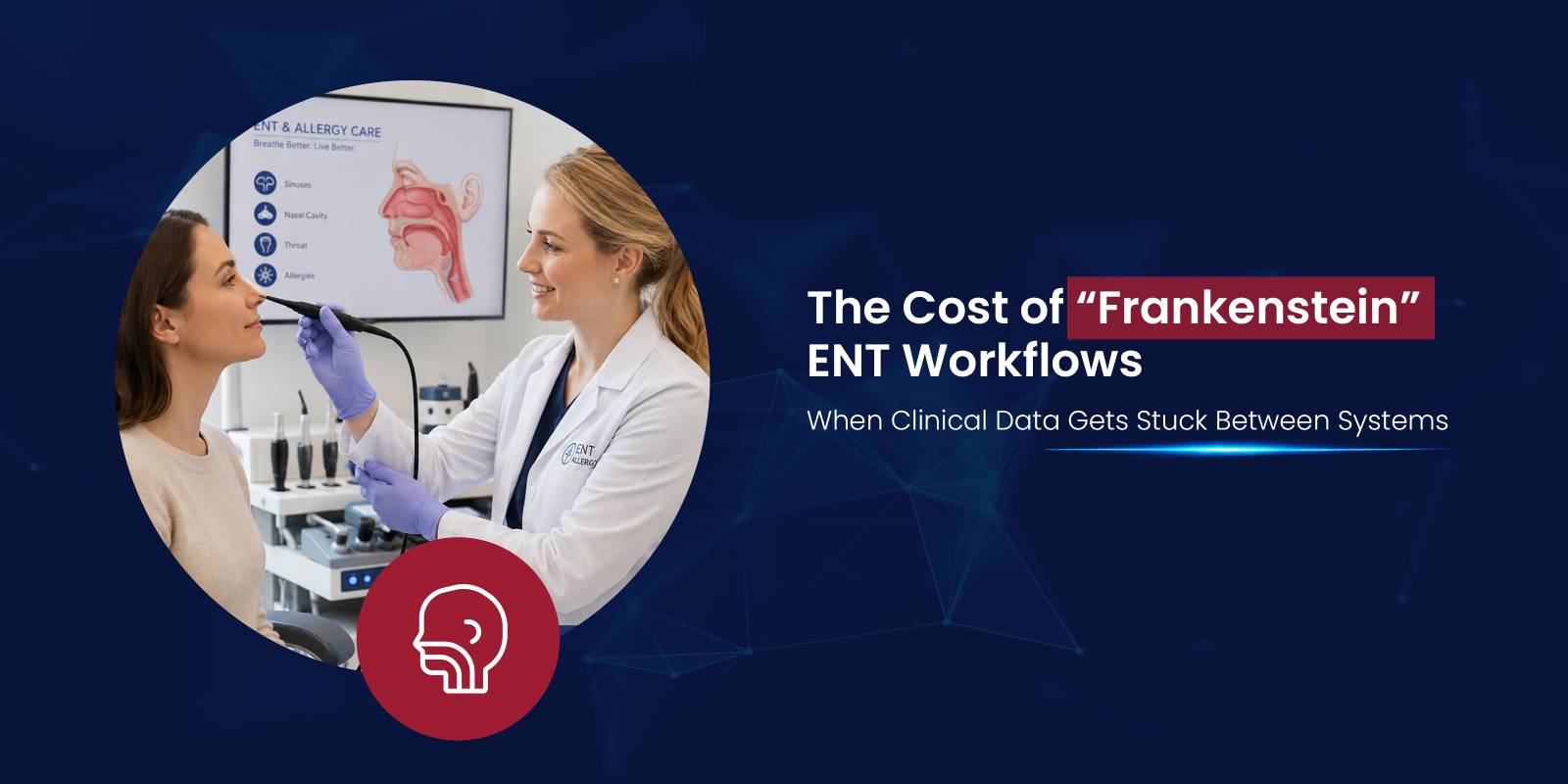
ENT practices have become increasingly complex environments. An otolaryngology practice
may manage routine ENT visits, procedures, allergy testing, immunotherapy, patient
communication,
billing, and revenue cycle
activities, all within the same patient journey.
The challenge isn’t necessarily having technology for each function. The challenge
begins when those functions operate as disconnected pieces.
An EHR manages clinical documentation. An allergy workflow handles testing and
immunotherapy. Inventory may be tracked separately. Billing operates through another
system. Patient communication may happen through yet another tool.
Individually, these systems may work well. Together, they can create what we call a
“Frankenstein” workflow, a practice workflow assembled from separate pieces that require
staff to manually connect them. And those connections can come at a cost.
What Is a “Frankenstein” ENT Workflow?
“Frankenstein workflow” isn’t a formal healthcare or technology term. It is a simple way to describe what happens when multiple systems are stitched together to manage one connected patient journey.
Consider an ENT practice that also provides allergy services. A typical workflow may move through:
Ideally, information captured at one stage should support the next. But if those stages live in different systems, staff may become the connection between them, copying information, verifying records, updating spreadsheets, reconciling data, or confirming that a charge or treatment activity was captured correctly.
The systems just weren't built to talk to each other, so people have to fill the gap.
The Hidden Cost Is in the Handoffs
The cost of fragmented workflows is rarely one large expense.
Instead, it can appear through dozens of small administrative tasks. A staff member might have to:
- Re-enter information into another system
- Locate allergy testing information
- Verify treatment details
- Update inventory separately
- Confirm immunotherapy documentation
- Check whether applicable charges were captured
- Reconcile information before claim submission
- Search multiple systems when resolving a denial
- Repeat information when communicating with patients
One task might take only a few minutes. Across a busy ENT allergy practice, those minutes can accumulate, creating additional administrative work that may not directly contribute to patient care or practice growth.
Where the Frankenstein Workflow Appears
Why accurate ICD-10-CM coding matters
ENT practices that provide allergy services may need to document both otolaryngology and allergy-related care. When those workflows are separated, information may have to be transferred between systems or entered more than once, creating additional work for clinical staff and increasing the number of places where information can become inconsistent. A more connected workflow allows ENT documentation and allergy management to operate within the same broader clinical environment.
Allergy Testing and MQT
Skin prick testing, intradermal testing, and Modified Quantitative Testing (MQT) can become part of the patient’s broader allergy workflow. When testing information is isolated from the rest of the clinical record, staff may have to bridge the gap manually. The issue isn’t simply where testing is documented, it’s whether that information can support the next clinical decision, remain accessible as treatment progresses, and ultimately support appropriate documentation and billing.
Immunotherapy and Treatment Tracking
Immunotherapy introduces an ongoing workflow rather than a single event. Treatment schedules, dosage calculations, progress tracking, and related documentation can generate information that needs to remain connected over time. When these processes depend on separate tools, staff may have to maintain parallel records, another handoff, another opportunity for re-entry or reconciliation.
Inventory and Allergy Operations
Inventory becomes particularly important when allergy services involve antigen or serum management. If inventory information is maintained separately from the clinical and treatment workflow, staff may need to move between systems to understand what is available, what is being used, and how it relates to patient treatment. As volume increases, maintaining information across multiple locations can become increasingly difficult.
Clinical Activity and Charge Capture
A service documented during an encounter may need to become a charge and ultimately a claim. If the clinical and billing workflows are disconnected, staff may have to determine whether the services performed were appropriately captured, a handoff that becomes more vulnerable to delays and missed information when it requires manual reconciliation between systems.
Claims, Payments and Denials
If a claim is denied, billing teams may need to investigate what happened earlier in the process. Was documentation sufficient? Was the correct service captured? When the underlying information is spread across multiple systems, identifying the source of the problem, and tracing the journey backward, can take additional time.
Whenever that answer depends on staff cross-checking two separate systems, delays and missed charges become more likely.
The Cost Is Bigger Than Technology
It’s easy to think about fragmented workflows as a software problem. But the bigger issue is operational dependency. When staff have to connect systems manually, the practice is effectively relying on people to perform the integration.
| Impact Area | What Fragmentation Costs |
|---|---|
| Productivity | Staff spend time moving information instead of working on higher-value activities. |
| Consistency | The same information may need to be entered or maintained in multiple places. |
| Visibility | Practice leaders may not have a complete view of clinical, operational, and financial activity. |
| Scalability | Manual processes that work at lower volumes can become increasingly difficult as the practice grows. |
| Revenue Integrity | Gaps between documentation, charge capture, and billing can create opportunities for missed or delayed revenue. |
The individual problems may seem small. Together, they create friction throughout the practice.
The Alternative: One Connected ENT Allergy Workflow
The bigger question is whether the systems supporting the practice can share information across the workflow without forcing staff to bridge every gap manually.
Instead of forcing staff to repeatedly move information between unrelated systems, the workflow can be designed around the patient’s complete journey. This is where an integrated specialty platform can make a meaningful difference.
From “Frankenstein” to Connected Workflow
A “Frankenstein” workflow isn’t defined by having multiple technologies. It is defined by the manual work required to make those technologies function together. For ENT practices that combine otolaryngology and allergy services, that distinction matters.
The clinical workflow doesn’t exist in isolation. Allergy testing connects to treatment. Treatment connects to immunotherapy. Immunotherapy connects to inventory and ongoing documentation. Clinical activity connects to charge capture. Charges connect to claims. Claims connect to payments and denial management. And the entire process exists around the patient.
ModuleMD’s ENT Allergy solution brings these workflows together within a platform designed specifically for otolaryngology practices incorporating allergy care. It combines ENT-specific EHR capabilities, allergy testing and MQT workflows, immunotherapy management, billing and revenue cycle management, patient engagement, telehealth, mobile access, and iPad-based clinical workflows.
The real opportunity is to eliminate the manual work that appears between each stage of an ENT allergy workflow.
It’s about how much manual work sits between those systems.
One Practice. One Platform.
See how ModuleMD's ENT Allergy solution connects testing, treatment, inventory, and billing into one workflow.
BOOK A DEMO